
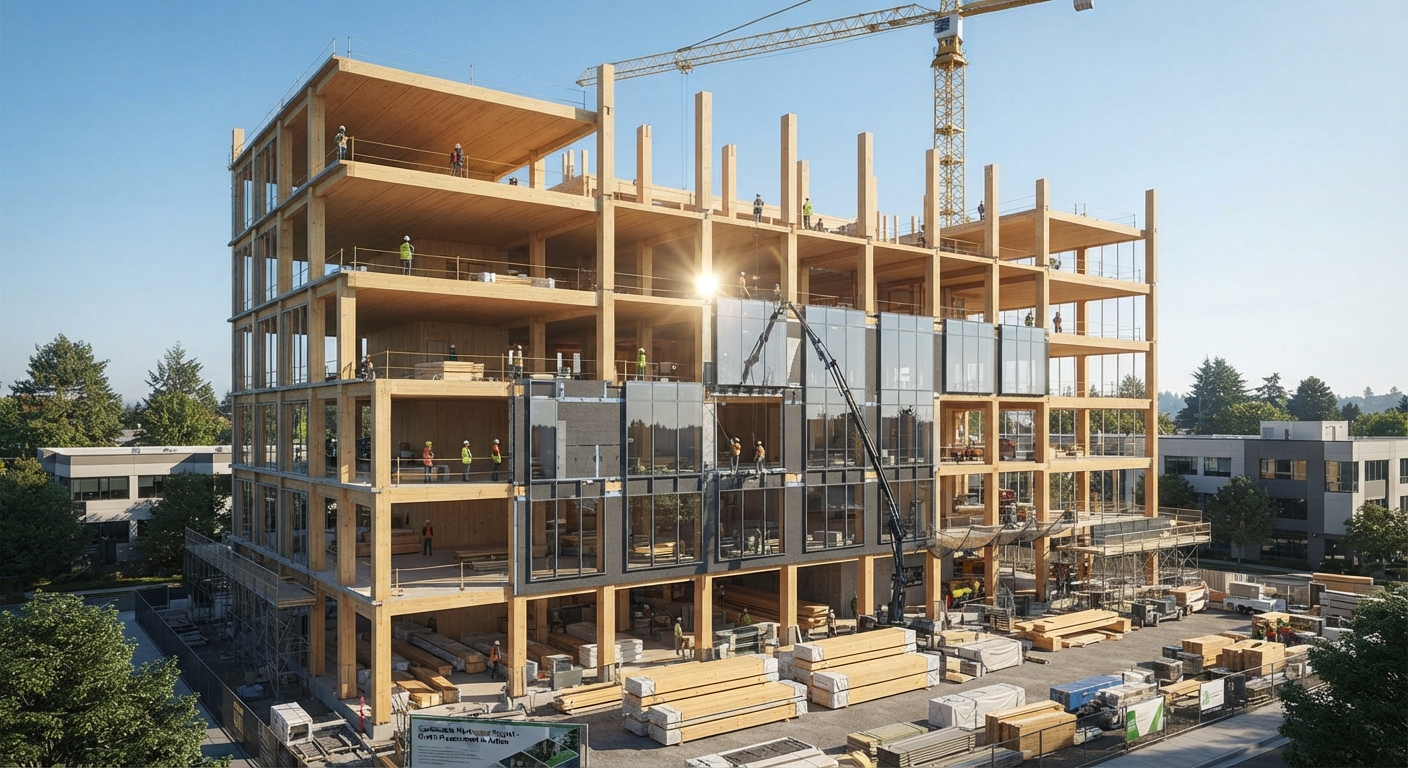
In commercial real estate, the transition toward net-zero building is moving at breakneck speed. Historically, developers have viewed sustainable procurement as a series of expensive add-ons or a rigid box-checking exercise during the tendering phase. However, applying advanced supply chain mechanisms—specifically combinatorial auctions—presents a massive opportunity to optimize both capital expenditure and environmental performance during the development of a new building. By moving away from traditional, fragmented contracting and allowing suppliers to bid on smart packages, developers can turn sustainability into a tangible financial asset.
Unlocking Economies of Scope in Construction Trades
Developing a new commercial office building involves deep interdependencies between core systems. For example, the energy efficiency of an office building relies entirely on how the facade insulation, glazing, and HVAC (heating, ventilation, and air conditioning) systems interact.
In a traditional tender, a developer requests separate, isolated bids for the glass curtain wall and the HVAC plant. A combinatorial auction framework changes this dynamic by empowering contractors to submit bundled proposals:
- Integrated Packaging: A contractor can offer a single, combined package for both high-performance smart glazing and a downsized, highly efficient HVAC system.
- Shared Cost Savings: Because they control both elements, they can optimize the engineering design, reduce their own contingency risk, and pass those economies of scope directly to the developer via discounted package pricing.
Implementing the Bonus-Malus Framework for Embodied Carbon
To truly embed sustainability into an asset’s financial bottom line, developers can adopt dynamic pricing mechanisms outlined in modern operational research. Rather than making “low-carbon materials” a simple pass/fail requirement, a Bonus-Malus system translates carbon into currency during the auction.
- The Green Bonus: If a structural steel supplier submits a bid utilizing 90% recycled electric arc furnace (EAF) steel, their financial bid receives a virtual “bonus” reduction. For the purpose of the auction evaluation, their price appears lower, rewarding their low embodied carbon.
- The Malus Penalty: Conversely, a supplier relying on high-carbon, traditional blast-furnace steel receives a financial “malus” penalty added to their evaluation price, holding them financially accountable for their environmental impact.
This allows the developer’s procurement team to mathematically balance upfront capital expenditure against long-term asset value, driven by a lower carbon footprint and higher BREEAM or LEED certifications.
Mitigating Developer Risk through Diversified Allocation
Relying entirely on a single tier-one contractor for an entire office development introduces immense counterparty risk. If that contractor faces insolvency or supply chain bottlenecks, the entire project stalls.
By utilizing bundled order allocation models, a developer can accept highly competitive packages while simultaneously enforcing safety constraints. This ensures that critical components—such as structural timber, concrete, and MEP (mechanical, electrical, plumbing) systems—are diversified across a resilient mix of trusted, green-certified suppliers.
Value Creation and Lower Risk
Developers who leverage combinatorial auctions allow the market to discover the most cost-effective engineering bundles. This approach directly monetizes carbon reductions while building highly resilient supply networks for next-generation buildings. Ultimately, these developers create superior asset value with significantly lower project risk.
Examples
1. Walmart’s New Home Office Campus (Bentonville, Arkansas)
- Building Finish Year: 2025–2026 (Initial facilities and buildings officially opened in January 2025, with phased rollouts and full corporate occupancy scaling through 2026).
- Application Mode: Mitigating Developer Risk through Diversified Allocation.
- Execution: Spanning 350 acres and over 2.4 million square feet, this corporate campus deployment serves as one of the largest modern applications of heavy mass timber. To safely execute a layout of this footprint without supply-chain stalls, procurement teams deployed optimized, bundled order allocation frameworks. This allowed them to divide immense volumes of glulam and cross-laminated timber across a highly resilient, diversified mix of regional, green-certified lumber suppliers.
2. Peel Regional Police Operational Support Facility (Brampton, Canada)
- Building Finish Year: 2026 (The state-of-the-art facility reached structural top-out and building enclosure completion in mid-2026).
- Application Mode: Risk-Mitigated Multi-Material Packaging.
- Execution: To safely manage counterparty risk on a critical, 24/7 municipal emergency building, procurement teams deployed optimized, multi-material allocation frameworks. This allowed them to capture the high-efficiency and cost-competitiveness of a prefabricated glulam post-and-beam superstructure while structurally verifying the diversification and financial resilience of the downstream supply chains.
3. Dquadro Headquarters Construction (Cuneo, Italy)
- Building Finish Year: 2024–2025 (Structural framing and specialized assembly completed rapidly in late 2024; active office operations commenced shortly thereafter).
- Application Mode: Unlocking Economies of Scope / Design for Assembly.
- Execution: In the development of the 7-story Dquadro headquarters, procurement teams rejected traditional, fragmented bidding models. Specialized trade contractors were invited to submit integrated “Design for Assembly” bundles that combined structural mass timber, concrete, and steel framing elements into single packages. Controlling these cross-trade components allowed suppliers to optimize building engineering, dramatically lower on-site risk premiums, and complete structural erection in just 30 days.
4. Liander Westpoort Regional Office (Amsterdam, Netherlands)
- Building Finish Year: 2023 (Construction successfully finalized and handed over in mid-2023).
- Application Mode: Bonus-Malus Framework for Circularity and Embodied Carbon.
- Execution: This award-winning facility for energy network operator Alliander was built entirely around the principles of circularity and carbon optimization. The developer’s procurement matrix mathematically balanced tight upfront budgets against long-term asset value by financially rewarding suppliers who successfully bundled bio-based material packages with low-carbon structural frame installations.
5. De Plataan Primary School (Merchtem, Belgium)
- Project Timeline: 2025–2026 (Phased construction actively unfolding through 2025 to enable uninterrupted schooling, with targeted completion by 2026).
- Procurement Mode: Multi-Material Green Packaging & Carbon Inversion.
- Execution: Handled by industrial contractor Jan De Nul, this new facility for 480 students relies on a highly integrated green material matrix. Instead of isolated trade contracting, the bidding model bundled cross-trade eco-materials—pairing 453 cubic meters of carbon-absorbing hemp blocks for the building envelope directly with an optimized structural wooden roof framework. Controlling the engineering of both components simultaneously minimized risk margins and maximized on-site structural carbon sequestration.
#RealEstate #innovation #sustainability #ValueCreation #procurement #CombinationalAuctions
Norbert Bol
Building Values

